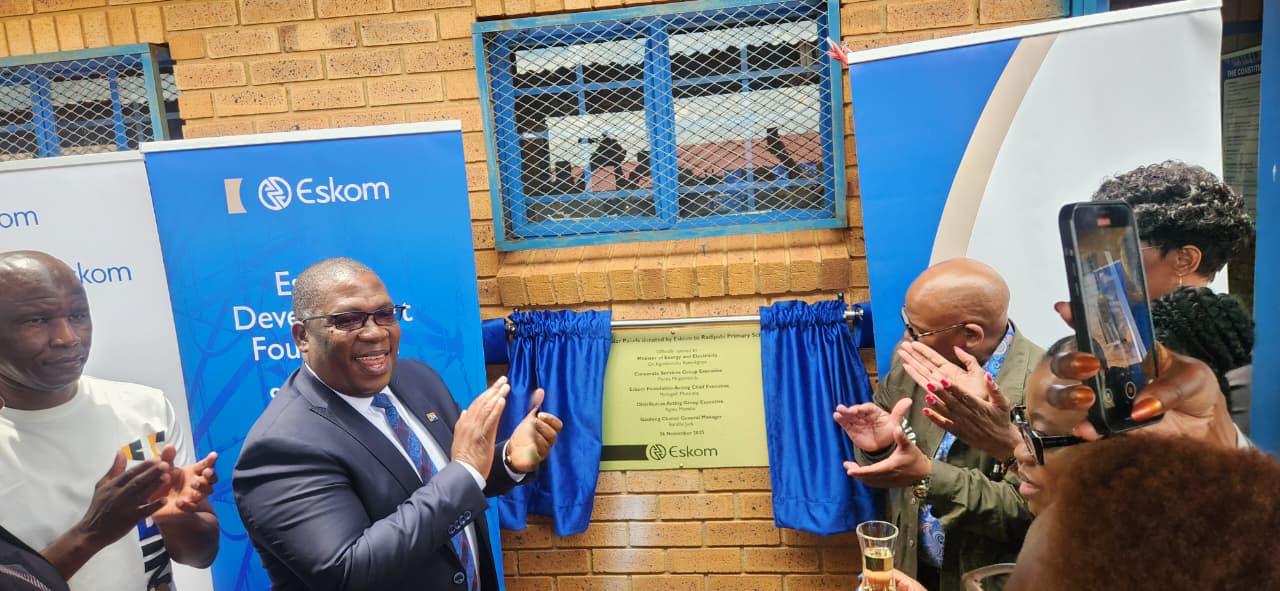
Panyaza Lesufi unveils solar installation at Radipabi Primary School, marking the start of its nationwide school solar rollout. Picture supplied.
Discover more
Entertainment center
School supplies
Education
Eskom, in conjunction with the Department of Basic Education (DBE) and the Department of Electricity and Energy (DEE), has begun to fulfil their promise to install solar panels in special and ordinary schools across the country to reduce the huge, erratic electricity costs charged to them, thanks to the Diary Series of Deaf People.
On 21 September, Diary Series of Deaf People published the three state entities’ commitment to run a programme to review the accounts of special schools, ensure schools are on appropriate tariffs and to install solar panels. Eskom stated that it will, however, broaden its project by delivering to both special and ordinary schools.
Eskom, DBE and DEE commenced their very first initiative on 26 November and handed over rooftop solar systems to five ordinary schools in Orange Farm: Radipabi Primary School, Aha-Thuto Secondary School, Laus Deo Primary School, Moyisela Primary School, and Mphethi Mahlatsi Secondary School.
Eskom national spokesperson Daphne Mokwena said through funding from its foundation, which has dedicated R146 million to social programmes for the 2025 financial year, Eskom installed “2 × 15kW inverters, 12 × 60kWh batteries and 40 × 620W solar panels” for each school."
Mokwena explained that the solar installation will result in the schools’ redirecting their government funds, “towards educational resources, maintenance, and other essential school needs, further enhancing the teaching and learning environment.”
She said it “was to enable Eskom to deliver reliable and sustainable power to schools most affected by electricity interruptions caused by infrastructure theft and vandalism.
“Orange Farm was identified as a community in urgent need due to the high prevalence of electricity infrastructure damage, which frequently disrupts learning and other essential services. The rooftop solar systems will ensure that the schools remain operational during supply interruptions, allowing teaching and learning to continue uninterrupted.”
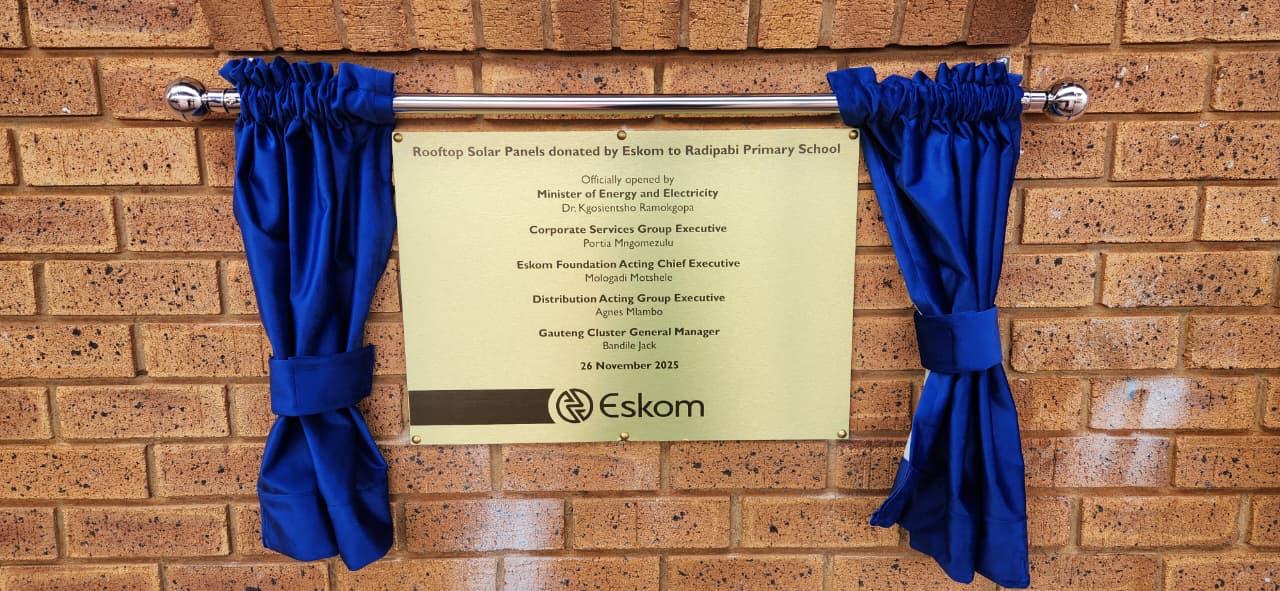
Handover of rooftop solar panels at Radipabi Primary School brings sustainable power and relief from high electricity costs. Picture supplied.
This commitment came after a story published by the Diary Series of Deaf People on 7 September 2025 on the high electricity costs charged to special schools in Limpopo, North West, Free State, Eastern Cape, Northern Cape, Western Cape and Mpumalanga.
The eight-month investigation, commissioned by the Southern Africa Accountability Project (SA|AJP) under the Henry Nxumalo Foundation, included a sample of 188 electricity bills from 66 special schools, which showed that most have high electricity costs that compromise the schools’ ability to purchase Learning and Teaching Support Materials (LTSM) such as textbooks, laptops, braille and other resources for deaf, blind learners and others with special needs. Laptops are indispensable for deaf pupils, as they are used for recording sign-language videos for lessons and exam responses.
Fixed Charges (NMD) Resulting in High Costs
The average monthly charge was R60,000, with some as high as R170,000. Charges did not drop during school holidays, when usage should be minimal.
In agreement with Diary Series of Deaf People’s findings, Eskom confirmed during a virtual call with our team on 12 September that one of the primary causes for large bills, even during times of low usage is high Notified Maximum Demand (NMD) charges. NMD relates to the highest amount of electricity a customer is allowed to draw from the grid at any time without incurring penalties and is measured in kilovolt-amperes (kVa). These are similar to the new connectivity charges homeowners who have fitted solar are facing.
READ: Eskom, Energy and Basic Education Ministers to install solar panels for the special schools
Many schools are paying for connections in excess of 300kVa, which is the equivalent of around 70 homes, but they only use a fraction of the available capacity.
Sadly, there is no automatic review triggered if a school consistently underutilises its connection over a period of years and could save money by downgrading to a lower NMD.
However, some of the schools interviewed said they have requested reviews and kVa downgrades but have not received any help from Eskom. Bosele School for the Blind and Deaf in Limpopo explained that although they had looked into downgrading their tariff, they were informed by Eskom that it would cost them around R100,000 to downgrade, which is the same amount they pay monthly on electricity charges.
Eskom Turns to Solar as Cushion Against Overpriced School Electricity Bills
Eskom used the solar system as a solution to reducing electricity costs for the five schools in Orange Farm.
Eskom Executive
Eskom’s Acting Group Executive for Distribution, Agnes Mlambo said:
“This initiative reflects Eskom’s collective commitment to the communities we serve, and our shared responsibility to support the youth. When we invest in schools, we invest in our children and in South Africa’s future. We encourage the community to protect this infrastructure so it can continue to provide light, hope, and opportunity for generations to come.”
Eskom said the programme will continue nationally with support from the DBE, other corporate partners and its customers.
Ntokozo Abraham is an economic and data journalist, Vicky Abraham, an investigative journalist of Diary Series of Deaf People (www.thedeafdiary.com) and Adam Oxford a data journalist and founder of Area of Effect (areaofeffect.tv). This investigation is produced by the Southern Africa Accountability Journalism Project (SA | AJP), an initiative of the Henry Nxumalo Foundation with the financial assistance of the European Union. It can under no circumstances be regarded as reflecting the position of the European Union.